

 English
 中文简体
DOA, or dioctyl adipate, is the plasticizer people reach for when a compound has to stay soft in the cold. If you have ever unrolled a garden hose on a frosty morning and watched it crack at the bend, you have met the problem this ester solves. DOA is chemically straightforward, blends easily, and remains one of the few general-purpose plasticizers that keeps flexible PVC pliable far below freezing.
Below we walk through what DOA actually is, where it performs best, where it has limits, and how to pick a grade that suits your process rather than fighting it.
Content
What Is DOA (Dioctyl Adipate)?
DOA is the short name for bis(2-ethylhexyl) adipate, also written as di(2-ethylhexyl) adipate or DEHA. It is the diester formed when adipic acid reacts with 2-ethylhexyl alcohol. The result is a clear, almost colourless oily liquid with a faint, mild odour, a molecular formula of C22H42O4 and a molecular weight of roughly 370.6 g/mol. Its CAS number is 123-79-5.
DOA dissolves readily in most organic solvents and in other plasticizer systems, and it is practically insoluble in water. That combination is exactly what you want in a wet or humid service environment: the plasticizer stays in the compound instead of leaching into moisture. Because it is a linear adipate rather than a phthalate, it solvates PVC quickly and pulls the glass transition of the compound downward.
One small note on names. In logistics and medicine, DOA often stands for "dead on arrival". In plastics and rubber, the abbreviation always means dioctyl adipate, and that is the meaning used throughout this page.
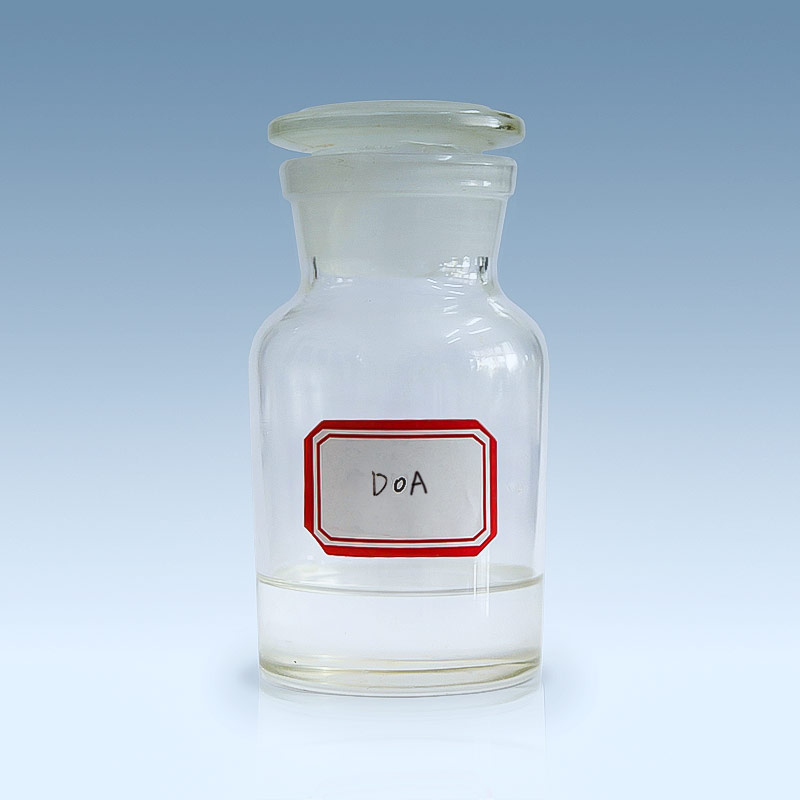 Dioctyl Adipate (DOA) Cold-Resistant PlasticizerA transparent oily liquid plasticizer for PVC and rubber, with typical commercial figures provided as a starting point for formulation.View Product →
Key Properties at a Glance
The figures below describe typical commercial material. They are a starting point for formulation work, not a substitute for the certificate of analysis that ships with your drum.
| Property | Typical value | What it means in practice |
|---|---|---|
| Appearance | Clear, colourless to pale yellow oily liquid | Easy to inspect and pump |
| Molecular formula | C22H42O4, MW around 370.6 | Linear adipate diester |
| CAS number | 123-79-5 | Standard purchasing reference |
| Density at 20 °C | About 0.925 g/cm³ | Close to compound density, so little settling in storage |
| Viscosity at 20 °C | About 13 to 15 mPa·s | Low viscosity, good wetting and fast fusion |
| Pour point | Around −70 °C or lower | The main reason formulators choose DOA |
| Flash point | About 205 °C | Ordinary precautions for a combustible organic liquid |
| Ester content | 99% or higher | Consistent plasticizing efficiency batch to batch |
| Water solubility | Below 0.01 g per 100 mL | Stays in the compound in damp or wet service |
Why DOA Excels in the Cold
The strongest argument for dioctyl adipate is low-temperature performance. Its pour point sits far below anything a finished PVC article will meet in service, and its low viscosity means it wets resin particles quickly during dry blending. In flexible PVC, DOA lowers the brittle point markedly even at moderate loading, which is why it is so often used as a secondary plasticizer at 10 to 30 phr alongside a phthalate, or as the primary plasticizer at 40 to 60 phr when cold flexibility is the design target.
It also brings benefits beyond temperature. Compounds containing DOA tend to fuse faster and run at lower melt viscosity, which can help extrusion throughput and reduce energy demand on the line. Adipates are frequently used to soften nitrocellulose, acrylic and rubber-based systems as well, where the same combination of solvating power and flexibility applies.
If you are weighing DOA against a phthalate for a cold-chain, outdoor or winter-installation application, a side-by-side look at DOA versus other plasticizers is a sensible place to start before you commit to a formulation.
The trade-off you should plan for
Adipates are more volatile and more readily extracted than the heavier phthalates. In thin sections, high-surface-area articles or hot service, DOA can migrate or evaporate faster than DOP, DOTP or TOTM would. Experienced formulators handle this in one of two ways: keep DOA as a secondary plasticizer that buys cold flexibility while a heavier ester carries permanence, or accept the trade-off knowingly in applications where cold performance matters more than ten-year retention, such as seasonal film or cold-store cable.
Where DOA Is Used
Because it is a general-purpose ester with a genuine low-temperature advantage, DOA turns up across a wide spread of industries:
- Wire and cable insulation and jacketing, particularly cords and cables used outdoors, in cold rooms or on construction sites.
- Film and sheeting, including stretch film, shrink film and, where local rules allow, food-contact film.
- Coated fabrics and artificial leather for upholstery, tarpaulins and conveyor belting.
- Footwear, gloves, hose and profiles that must stay supple below zero.
- Adhesives, sealants and printing inks, where it acts as a softener and viscosity modifier.
- Rubber compounds and low-temperature lubricant base fluids, where adipates have a long history.
DOA Compared With Other Plasticizers
No single ester wins everywhere. The table below gives a rough positioning of DOA against the plasticizers it most often meets in a formulation discussion.
| Plasticizer | Low-temperature flexibility | Permanence | Typical fit |
|---|---|---|---|
| DOA | Excellent | Moderate | Cold-service PVC, film, cable, coated fabric |
| DOP | Moderate | Good | General-purpose, cost-driven compounds |
| DINP | Moderate | Good | High-volume PVC with a better volatility profile |
| DOTP | Good | Very good | Phthalate-free general-purpose work |
| TOTM | Fair to moderate | Excellent | High-temperature cable, automotive, medical articles |
In practice, blends do most of the work. A pair such as DOA for cold flexibility plus a heavier phthalate-free ester for permanence often outperforms either material alone, and the cost balance usually lands in a sensible place too.
 Dioctyl Terephthalate (DOTP) for PVC Cable MaterialsA stable plasticizer with good cold and heat resistance, suited to high-insulation PVC cable compounds and plastisol viscosity control.View Product →
Handling, Storage and Safety Notes
DOA has a long record of industrial use and a low order of acute toxicity. It is not a skin sensitiser in normal handling, but standard hygiene practice still applies: gloves and eye protection when decanting, adequate ventilation, and no eating or smoking in the work area.
Regulatory status is the part that deserves real attention. Rules for food-contact film, toys, childcare articles and medical devices differ between regions and are revised from time to time, and adipates are not exempt from that scrutiny. Before you design a product around DOA, confirm the current position for your end market with your compliance team rather than relying on a data sheet from several years ago.
For storage, keep DOA in closed, clearly labelled steel drums or intermediate bulk containers, out of direct sunlight and away from strong oxidisers. The material picks up very little moisture, but drums left open in humid weather will still draw condensation over time. Most suppliers quote a shelf life of around two years in unopened packaging, and a nitrogen blanket is a reasonable precaution for long-term tank storage.
How to Choose a DOA Grade
A short checklist saves a lot of back-and-forth:
- Confirm the specification: ester content, acid value, colour in APHA units, moisture and volatility.
- Match the plasticizer to the coldest service temperature the article will actually see, not the average.
- Decide whether DOA is primary or secondary in your formulation, since that sets the loading range.
- Check the regulatory status for the specific end use and destination market.
- Run a lab trial: fusion behaviour, brittle point and heat ageing on your own compound tell you more than any generic table.
- Agree packaging, drum or IBC, and delivery schedule before the first bulk order.
Sourcing DOA From a Manufacturer
Zhejiang Great Chemical Science & Technology has been producing plasticizers since 2008, and DOA sits in a family that also includes DOP, DOTP, DINP, TOTM and phthalic anhydride. Our plant covers roughly 125 acres on the north bank of the Qiantang River crossing, about three kilometres from Jiaxing Port, with several expressway links close by, which keeps both domestic deliveries and export shipments straightforward.
Around 180 people work on the site, including a technical group that spends most of its time on formulation questions rather than paperwork. In practice that means you can send us a compound brief and get a sensible answer about loading levels, blending partners and expected low-temperature behaviour, not just a price. All of our products are stated to meet national high-grade standards, and our environmentally friendly plasticizers are made to EU-standard requirements.
If you would like to see the wider picture, our plasticizer range lists every grade we produce, and samples are available for evaluation before you commit to volume.
DOA is a specialist rather than a universal answer, and it rewards formulators who understand that. Use it for cold flexibility, blend it when you need permanence as well, and check the regulations that apply to your market before the first production run. Handled that way, dioctyl adipate remains one of the most dependable tools in flexible PVC compounding.