

 English
 中文简体
中文简体Content
Why Grade and Purity Matter More Than You Think
Not all TOTM plasticizer products on the market are equal. While they share the same chemical identity — Tris(2-ethylhexyl) trimellitate — the purity level, color, acid value, moisture content, and residual catalyst all vary between manufacturers and even between production batches. These differences have real, measurable effects on how the plasticizer performs in your PVC compound, how it behaves during processing, and whether the finished product will pass quality and regulatory testing.
For a commodity plastic application where margins are thin and thermal performance requirements are modest, small variations in plasticizer quality may be tolerable. But for automotive wire insulation rated at 105°C, blood bags that contact human blood, or medical tubing used in critical care — these variations can translate into field failures, failed certifications, or customer complaints. Understanding what specifications to ask for and how to evaluate them is an essential skill for any formulator or procurement professional working with TOTM.
Key Specifications to Evaluate When Sourcing TOTM
When requesting a technical data sheet or certificate of analysis from a TOTM plasticizer supplier, focus on the following parameters:
Purity (TOTM Content %)
High-quality TOTM should have a purity of ≥99.0% by GC analysis. Lower purity grades may contain unreacted alcohol, partial esters (mono- or di-esters of trimellitic acid), or isomeric byproducts. These impurities are more volatile and more prone to migration than TOTM itself, which partially defeats the purpose of using a high-performance trimellitate plasticizer. For medical-grade applications, purity specifications of ≥99.5% are commonly required.
Acid Value
The acid value (expressed in mg KOH/g) indicates how much free acid remains in the product after esterification. A high acid value can cause PVC degradation during processing by promoting dehydrochlorination of the polymer. It can also attack metal tooling and molds over time. A good TOTM specification requires an acid value of ≤0.1 mg KOH/g; the best-grade products achieve ≤0.05 mg KOH/g.
Color (APHA / Hazen)
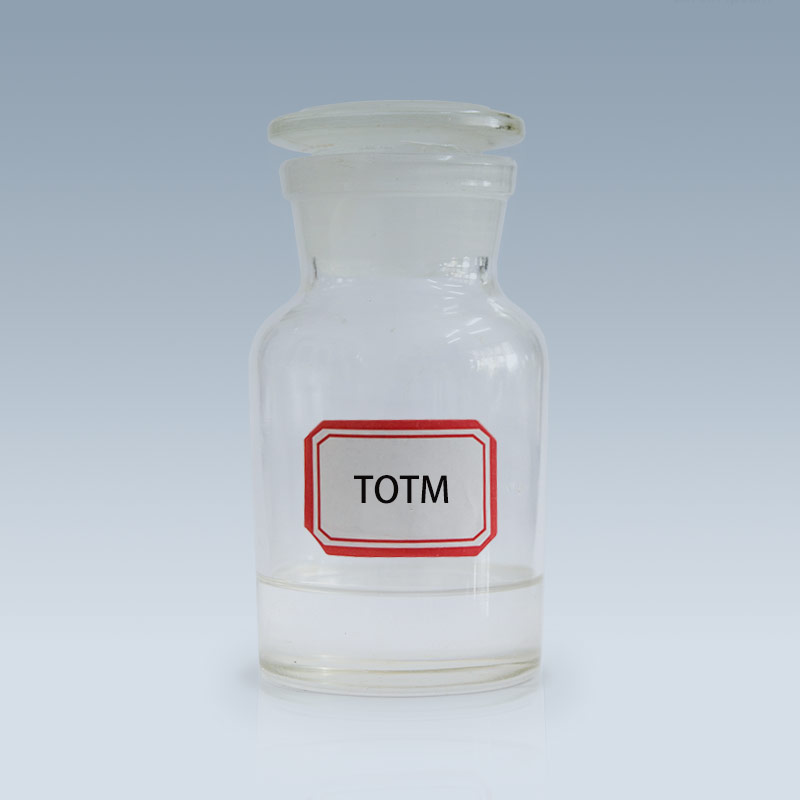
TOTM is naturally a very pale yellow liquid. Color is measured on the APHA/Hazen scale, where lower numbers indicate a cleaner, lighter product. For most cable applications, APHA ≤50 is acceptable. For medical and light-colored PVC applications, APHA ≤30 or even ≤20 is preferred, as higher color values can affect the final product's appearance, especially in transparent or light-colored formulations.
Moisture Content
Moisture in plasticizers causes problems during PVC processing: it generates steam, promotes polymer degradation, and can cause surface defects or voids in extruded products. TOTM should have a moisture content of ≤0.1% (1000 ppm) by Karl Fischer titration. For sensitive applications and high-speed extrusion lines, ≤500 ppm is advisable.
Viscosity
TOTM's viscosity at 25°C typically runs between 150–200 mPa·s. Significant deviation from this range may indicate batch-to-batch variability in molecular weight distribution or the presence of heavier or lighter impurities. Viscosity consistency is particularly important for manufacturers running automated plasticizer dosing systems, where viscosity affects flow rate and dosing accuracy.
TOTM Grades for Different Industries
Different end-use industries have different priorities when it comes to TOTM plasticizer selection. Here is a practical breakdown:
| Industry | Priority Specs | Typical Purity | Key Certifications |
| Automotive Wire | Low volatility, heat aging, UL 105°C rating | ≥99.0% | UL, IATF 16949 supply chain |
| Medical Devices | Ultra-low migration, toxicological data, extractables | ≥99.5% | ISO 10993, FDA DMF |
| Industrial Cable | Oil/solvent resistance, mechanical properties | ≥99.0% | REACH compliance, RoHS |
| Automotive Interior | Low fogging, low odor, color stability | ≥99.0% | VDA 278, OEM specs |
| Food Packaging | Low migration, food contact compliance | ≥99.5% | EU 10/2011, FDA 21 CFR |
Medical and food-contact applications have the strictest requirements, partly because regulatory frameworks demand extensive toxicological dossiers and extractables/leachables testing. If you are developing a medical device or food-contact product using TOTM-plasticized PVC, ask your supplier for a full toxicological summary and, if applicable, a Drug Master File (DMF) reference or EU Food Contact declaration.
How to Evaluate a TOTM Plasticizer Supplier
Supplier selection for TOTM goes beyond comparing price per ton. Here are the most important factors to assess during supplier qualification:
- Technical documentation: A serious TOTM supplier should provide a full technical data sheet (TDS), safety data sheet (SDS), and certificate of analysis (CoA) for each batch. Reluctance to share these documents is a red flag. The CoA should include test results for purity, acid value, color, viscosity, moisture, and specific gravity at minimum.
- Batch-to-batch consistency: Ask for CoA data from at least three to five recent production batches. This lets you assess how tight their manufacturing controls are. High variance between batches in purity or color is a sign of inconsistent production — a problem when you are trying to maintain a qualified PVC formulation.
- REACH and RoHS compliance: Confirm that the supplier provides a current REACH SVHC declaration and, if relevant for your application, a RoHS compliance statement. These are especially important for products sold into the EU market.
- Production capacity and supply security: TOTM is a specialty chemical with fewer global producers than commodity phthalates. Verify the supplier's production capacity, typical lead times, and whether they maintain safety stock. Supply disruptions in specialty plasticizers can halt production lines with very little warning.
- Regulatory support: For medical or food-contact applications, check whether the supplier has filed a relevant DMF with the FDA or can provide a declaration of conformity under EU Regulation 10/2011. Suppliers who actively support their customers' regulatory submissions are valuable partners, not just commodity vendors.
Common Formulation Mistakes When Using TOTM Plasticizer
Even experienced PVC compounders sometimes run into avoidable issues when working with TOTM. Here are the most common mistakes and how to avoid them:
Assuming TOTM Is a Drop-In Replacement for DEHP
TOTM has a higher viscosity and slightly different solvation kinetics compared to DEHP. Simply swapping TOTM into a DEHP formulation at the same loading level without adjustment can result in longer dry-blend times, different processing temperatures, and slightly different mechanical properties in the final compound. Always run lab trials and recharacterize the compound after any plasticizer substitution.
Underestimating the Effect on Cold Flexibility
TOTM provides excellent heat resistance, but it is not a standout performer at low temperatures. Products that need both 105°C heat rating and flexibility at -40°C — such as automotive cables in cold climates — may need a blend of TOTM with a low-temperature plasticizer such as DOA (dioctyl adipate) or DIDA (diisodecyl adipate). Pure TOTM compounds can become stiff at temperatures well below 0°C, which may fail cold-bend or impact tests.
Using the Wrong Heat Stabilizer System
The heat stabilizer system in your PVC compound works hand-in-hand with the plasticizer to determine processing stability and long-term heat aging performance. For TOTM-based compounds targeting 105°C continuous service, an adequate heat stabilizer loading is critical. Under-stabilized formulations will pass initial heat aging tests but fail over longer exposure periods. Work with your stabilizer supplier to validate the stabilizer package specifically for your TOTM compound.
Neglecting to Validate Migration in the Final Assembly
TOTM has excellent migration resistance in standalone PVC test specimens, but migration behavior can change significantly when the plasticized PVC is in contact with other materials — rubber seals, foam insulation, adhesive tapes, or packaging films. Always validate migration performance in the actual assembly configuration, not just in PVC-to-PVC or PVC-to-air scenarios.
What the Future Looks Like for TOTM Plasticizer
The global demand for TOTM trimellitate plasticizer is expected to grow steadily over the coming years, driven by three converging trends. First, the ongoing regulatory pressure on phthalate plasticizers in Europe, North America, and increasingly in Asia-Pacific is pushing formulators toward alternatives like TOTM. Second, the electrification of vehicles is dramatically increasing the volume of automotive wiring, and much of that wiring demands 105°C-rated, TOTM-plasticized insulation. Third, the expansion of healthcare infrastructure globally is driving demand for safer, non-phthalate medical PVC.
At the same time, TOTM faces competition from newer non-phthalate plasticizers such as DINCH (diisononyl cyclohexane-1,2-dicarboxylate) and bio-based alternatives like acetylated castor oil derivatives. These alternatives address certain market niches — particularly in consumer products and food contact — but none of them match TOTM's combination of heat resistance, low migration, and established regulatory track record for high-temperature wire and cable applications. For the foreseeable future, TOTM remains the benchmark trimellitate plasticizer for demanding thermal applications, and understanding how to use it effectively is a skill that will continue to pay dividends for PVC compounders and product engineers alike.