

 English
 中文简体
中文简体Content
- 1 What Makes TOTM Plasticizer Different from Regular Plasticizers
- 2 Key Physical and Chemical Properties of TOTM
- 3 Where TOTM Plasticizer Is Commonly Used
- 4 TOTM vs. Other Common Plasticizers: A Direct Comparison
- 5 Safety Profile and Regulatory Status of TOTM Plasticizer
- 6 Practical Tips for Using TOTM in PVC Formulations
What Makes TOTM Plasticizer Different from Regular Plasticizers
TOTM plasticizer — short for Trioctyl Trimellitate (also written as Tris(2-ethylhexyl) trimellitate) — is a high-performance plasticizer belonging to the trimellitate ester family. Unlike conventional phthalate-based plasticizers such as DEHP or DINP, TOTM is built around a trimellitic acid backbone, which gives it three ester linkages instead of two. This structural difference is the core reason why TOTM performs significantly better under heat, low-volatility conditions, and demanding regulatory environments.
Standard plasticizers work by embedding themselves between polymer chains, reducing intermolecular forces and increasing flexibility. TOTM does the same thing, but because its molecular weight is higher (around 547 g/mol), it migrates out of the material far more slowly. This means products made with TOTM-plasticized PVC stay flexible longer, hold their properties in high-temperature environments, and lose less plasticizer through evaporation or extraction over time.
TOTM is most commonly used as a primary plasticizer in PVC compounds, though it can also function as a secondary plasticizer blended with others to improve thermal stability without fully replacing a base plasticizer. Its compatibility with PVC is excellent, and it shows good resistance to oil, water, and soap extraction — properties that matter greatly in electrical and medical applications.
Key Physical and Chemical Properties of TOTM
Understanding the technical profile of TOTM plasticizer helps explain why it is specified for demanding applications. Below is a summary of its most important characteristics:
| Property | Value / Description |
| Chemical Name | Tris(2-ethylhexyl) trimellitate |
| CAS Number | 3319-31-1 |
| Molecular Weight | ~547 g/mol |
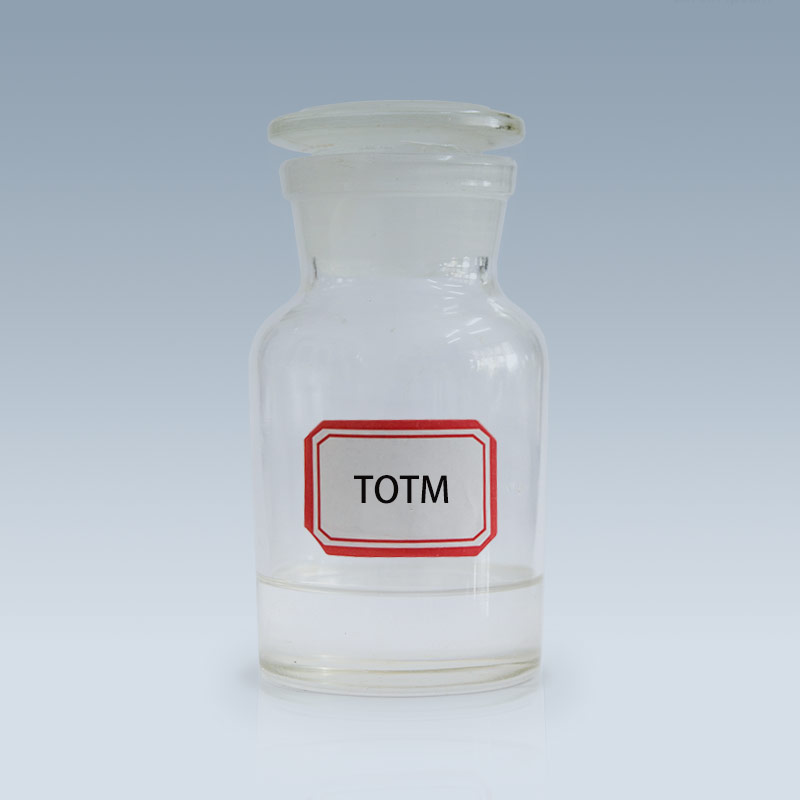
| Appearance | Clear, light yellow oily liquid |
| Boiling Point | >400°C |
| Flash Point | ~260°C |
| Viscosity (at 25°C) | ~150–200 mPa·s |
| Volatility | Very low — superior to DEHP and DINP |
| Migration Resistance | Excellent |
| Continuous Service Temp. | Up to 105°C |
The boiling point above 400°C is particularly significant. It means TOTM-plasticized PVC cables and components can be used in environments where surface temperatures regularly exceed 90°C without experiencing the fogging, surface bleed-out, or stiffening that would occur with lower-grade plasticizers. The high flash point also contributes to safer processing and end-use applications.
Where TOTM Plasticizer Is Commonly Used
TOTM trimellitate plasticizer has carved out a strong niche in industries where heat resistance, low migration, and regulatory compliance are non-negotiable. Its main application areas include:
Wire and Cable Insulation
This is by far the largest end-use market for TOTM. Automotive wiring harnesses, appliance wiring, and industrial power cables rated at 105°C or higher routinely specify TOTM-plasticized PVC compounds. In automotive applications, wires run close to engines and exhaust systems where underhood temperatures can spike above 100°C for extended periods. A cable that loses plasticizer under these conditions will crack, become brittle, and eventually fail — a serious safety risk. TOTM's low volatility prevents this degradation, making it the plasticizer of choice for UL 105°C wire insulation standards and equivalent international certifications.
Medical Devices and Blood Bags
Medical-grade PVC has historically relied on DEHP (di(2-ethylhexyl) phthalate) as a plasticizer, but growing health concerns about phthalate migration into blood products and IV fluids have driven the medical industry toward TOTM as a safer alternative. TOTM-plasticized blood bags and IV tubing show substantially lower plasticizer extraction compared to DEHP counterparts. Several regulatory bodies and hospital procurement bodies in Europe and North America now prefer or mandate non-phthalate plasticizers in direct-contact medical devices, and TOTM meets these requirements effectively.
High-Temperature Industrial Applications
Industrial conveyor belts, hot-air duct liners, chemical-resistant gaskets, and protective sheathing for industrial equipment often use TOTM-plasticized PVC. These components are exposed to elevated temperatures, oils, and solvents that would rapidly degrade a standard phthalate-plasticized product. TOTM's resistance to oil extraction and its stability under continuous thermal stress make it the right choice for these demanding conditions.
Automotive Interior Components
Fogging in automotive interiors — the film that develops on windshields from plasticizer vapors migrating out of dashboards, door panels, and seat covers — is a well-known issue. TOTM's extremely low volatility dramatically reduces this effect, which is why automotive OEMs increasingly specify TOTM or similar trimellitate plasticizers for interior PVC components that face direct sun and high cabin temperatures.
TOTM vs. Other Common Plasticizers: A Direct Comparison
To put TOTM's advantages in context, it helps to compare it directly against the most widely used alternatives:
| Plasticizer | Type | Max Temp. | Volatility | Migration | Cost |
| DEHP | Phthalate | 70–80°C | High | High | Low |
| DINP | Phthalate | 85°C | Medium | Medium | Low-Med |
| TOTM | Trimellitate | 105°C | Very Low | Very Low | Medium-High |
| DOTP | Terephthalate | 90°C | Low | Low | Medium |
| ESBO | Epoxy | Secondary use | Low | Low | Medium |
The trade-off with TOTM is cost. It is more expensive than commodity phthalates like DEHP or DINP, which is why it is typically reserved for applications that genuinely require its superior performance rather than used as a general-purpose plasticizer. In high-value applications — automotive, medical, aerospace — the performance justification easily outweighs the cost premium.
Safety Profile and Regulatory Status of TOTM Plasticizer
One of TOTM's most important selling points is its favorable toxicological and regulatory profile relative to phthalate plasticizers. TOTM is not classified as a substance of very high concern (SVHC) under the EU's REACH regulation, unlike DEHP, DBP, and BBP, which are restricted phthalates. This distinction matters enormously for manufacturers exporting to the European Union, as restricted substances require authorization and face potential phase-out.
In the United States, TOTM is not listed as a hazardous air pollutant (HAP) under the Clean Air Act and is not subject to the phthalate restrictions under the Consumer Product Safety Improvement Act (CPSIA), which bans certain phthalates in children's toys and childcare articles. This regulatory freedom makes TOTM a compelling choice for manufacturers who want to future-proof their formulations against tightening chemical regulations.
From a toxicological standpoint, studies on TOTM have shown no evidence of reproductive toxicity or endocrine disruption at relevant exposure levels — a sharp contrast with the reproductive toxicity concerns that drove the regulatory action against DEHP. It is also poorly absorbed through intact skin, reducing dermal exposure risk during handling and manufacturing.
Practical Tips for Using TOTM in PVC Formulations
For compounders and product developers working with TOTM trimellitate plasticizer, a few practical considerations are worth keeping in mind:
- Processing temperature: TOTM has a higher viscosity than DEHP at room temperature, which means PVC compounds may require slightly higher processing temperatures or longer mixing times to achieve full incorporation. Typical processing temperatures of 160–180°C are effective.
- Loading levels: TOTM is typically used at 40–80 phr (parts per hundred resin) as a primary plasticizer. At these levels, it delivers good flexibility with excellent heat aging performance. Higher loading increases flexibility but may slightly reduce tensile strength.
- Heat stabilizer pairing: Calcium-zinc (Ca-Zn) and organotin stabilizers both work well with TOTM-based PVC compounds. The choice depends on the specific application, with Ca-Zn being preferred in food-contact or medical contexts for toxicological reasons.
- Blending with secondary plasticizers: In cost-sensitive formulations, TOTM is sometimes blended with DOTP or chlorinated paraffins to balance performance and price. This can work well as long as the secondary plasticizer doesn't significantly compromise the heat aging or migration resistance of the final compound.
- Storage: TOTM should be stored in sealed containers away from strong oxidizers and excessive heat. Shelf life under proper storage conditions is typically 24 months, and the product does not require any special temperature-controlled storage.
Overall, TOTM is a well-understood, technically proven plasticizer that delivers consistent results across a wide range of PVC applications. Its higher cost compared to phthalates is a real consideration, but for applications where thermal stability, low migration, and regulatory compliance are critical, TOTM remains one of the best options available in the market today.