

 English
 中文简体
Anyone who has spent time on a flexible PVC line knows the pattern: a compound that feels perfect at 25 °C can crack like a dry biscuit the moment a cold snap arrives. That is the gap DOA plasticizer was made to close. Dioctyl adipate has been the quiet workhorse behind cold-weather flexibility for decades, and even with a far wider choice of esters available today, formulators keep coming back to it.
What follows is a practical view of what DOA is, how it behaves inside a formulation, where it earns its cost, and the small details that decide whether a trial batch becomes a production specification.
Content
What DOA Plasticizer Actually Is
DOA, or dioctyl adipate, is also written as bis(2-ethylhexyl) adipate. It is a diester built from adipic acid and 2-ethylhexanol, carries the CAS number 103-23-1, and at room temperature is a clear, light-coloured, oily liquid: low in viscosity, mild in odour, and easy to pump, meter and blend. Nothing about handling it is dramatic, which is part of its appeal.
Chemically, the important point is what DOA is not. It is an adipate, not an orthophthalate. If a specification, a retail programme or an export market says "no orthophthalate", DOA keeps you inside those rules while still delivering ester-based performance. And if your compound is perfectly happy with phthalates, DOA is not a compromise either; it is simply a different tool with a different balance of properties.
Its solvating strength is moderate. DOA does not attack PVC as aggressively as a general-purpose phthalate does, so it gels more slowly and gives you a longer working window in plastisols and organosols. In exchange, it brings low-temperature performance that general-purpose esters struggle to match.
What DOA Brings to a Formulation
Ask an experienced compounder why DOA stays in the recipe and the answer usually covers four things.
- Cold-weather flexibility. DOA keeps PVC soft and pliable at temperatures where phthalate-only systems stiffen. Brittleness temperature and Clash-Berg stiffness are the tests where it shows best.
- Dependable heat and light stability. Compounds based on DOA hold their colour and their mechanical properties well through ageing, which matters for outdoor and long-service articles.
- Manageable volatility. For a monomeric ester of its size, weight loss during processing is modest, helping in wire and cable work and in any process with a long, hot residence time.
- Broad compatibility. DOA blends cleanly with PVC and with phthalate, terephthalate and trimellitate esters, so it can be introduced as a partial replacement without rebuilding the whole formulation from scratch.
Key Properties at a Glance
| Property | How it behaves | What it means for your compound |
|---|---|---|
| Ester family | Adipate diester, not an orthophthalate | Supports phthalate-free positioning without leaving ester chemistry behind |
| Appearance | Clear, light-coloured oily liquid | Low colour contribution and straightforward handling |
| Solvating strength | Moderate; gels more slowly than DOP | Longer working window in plastisols, but fusion needs checking |
| Low-temperature flexibility | Excellent | Stays soft in cold storage, winter service and outdoor use |
| Volatility | Low for a monomeric ester | Less weight loss across long, hot processing runs |
| Compatibility | Broad, with PVC and most common esters | Easy to slot into existing formulations as a co-plasticizer |
Where DOA Earns Its Place
DOA turns up wherever flexibility has to survive the cold or a long service life:
- Wire and cable jacketing and insulation, especially for outdoor and cold-climate installations.
- Automotive interiors such as skins, seals and gaskets, plus parts exposed to winter road conditions.
- Coated fabrics, tarpaulins, roofing membranes and conveyor belting.
- Freezer-grade film, refrigeration gaskets and cold-store sheeting.
- Plastisols and slush-moulded parts, where its slower gelation is an advantage rather than a nuisance.
- Rubber compounds, adhesives, sealants and inks, where it also works as a softener.
If that list looks like your own order book, the grade we produce is worth a closer look.
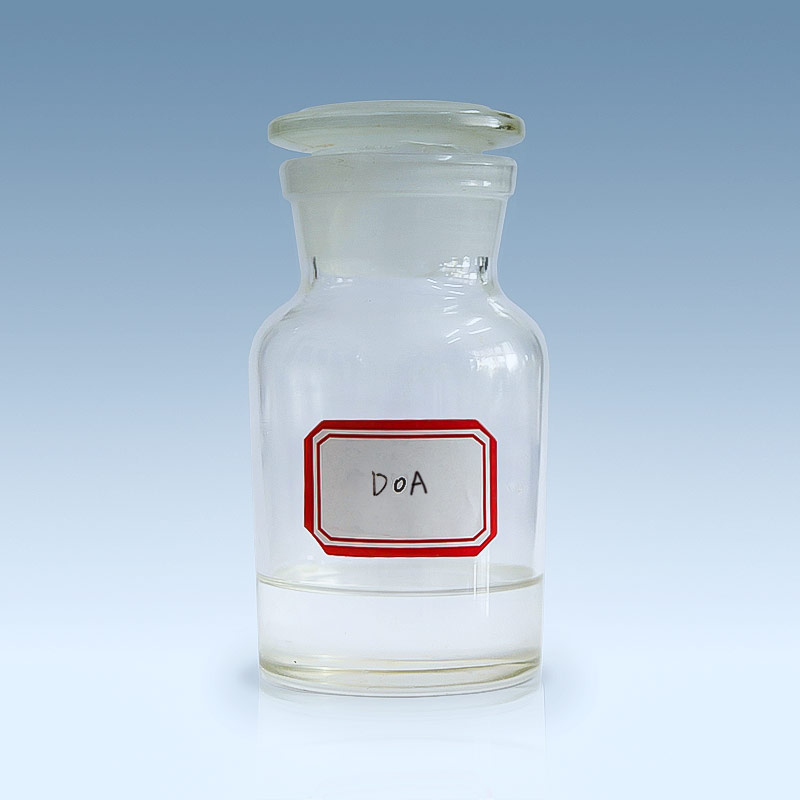 Dioctyl Adipate (DOA) Cold-Resistant PlasticizerDOA is a cold-resistant PVC plasticizer offering low-temperature flexibility and high plasticizing efficiency, often paired with primary esters.View Product →
DOA Alongside Other Plasticizers
Very few compounds run on a single ester. DOA is most often used as a co-plasticizer: the primary ester carries the bulk of the loading, while DOA buys low-temperature headroom that the primary simply cannot deliver on its own. That division of labour is easier to reason about when you know what the neighbours do.
- DOTP shares the non-orthophthalate story but brings higher permanence and better extraction resistance. Pairing it with DOA is a common route when a product needs both durability and cold flexibility.
- TOTM is the high-temperature specialist, with very low volatility, and is the usual choice for cable and under-hood work where heat ageing dominates.
- DINP and DOP remain the cost-efficient bulk of many general-purpose compounds, and DOA can be layered on top of either without compatibility trouble.
The practical advice is to change one variable at a time. Start with a modest substitution, keep the total plasticizer loading constant, and measure the properties you actually sell on rather than the ones that are quickest to test.
If you are comparing the terephthalate side of the family at the same time, our DOTP grade is the natural reference point.
 Dioctyl Terephthalate (DOTP) Plasticizer for PVC CableDOTP is a stable terephthalate plasticizer with strong electrical properties, suited to high-insulation PVC cable compounds and plastisol viscosity control.View Product →
Handling and Blending Notes from the Plant Floor
- Keep drums and tanks closed and out of direct sunlight. Follow the safety data sheet for personal protection and disposal, as you would with any ester.
- Warm the material in winter. Viscosity climbs as temperature falls, and a cold drum meters poorly and mixes unevenly.
- Re-check fusion, not just viscosity. Slower gelation changes the fusion curve, and a compound that looked right in the mixer may need a longer or hotter cycle downstream.
- Measure the property you are selling. Brittleness temperature and Clash-Berg stiffness tell the low-temperature story properly; a simple bend test at room temperature tells you almost nothing.
- Watch extraction and migration in the finished article, particularly where the part meets fats, oils or fuels in service.
We have written a longer note on why DOA suits low-temperature flexible PVC if you want the formulation-level detail.
Choosing a Supplier You Can Stay With
Zhejiang Great Chemical Science & Technology has been manufacturing plasticizers since 2008, from a site of roughly 125 acres near the north bank of the Qiantang River crossing, about three kilometres from Jiaxing port and well connected to the surrounding expressway network. The team runs to more than 180 people, and the product range covers DOP, DOTP, DINP, DOA, TOTM, DPHP and phthalic anhydride.
Our published capacity figures put plasticizer output at 150,000 tonnes a year alongside 50,000 tonnes of phthalic anhydride, while individual line ratings are quoted differently in different places. Rather than guess which number applies to your grade, ask us for the current line-specific figure before you plan a campaign around it.
In day-to-day terms, what matters is duller: consistent colour, consistent ester content, and a certificate of analysis that matches the drum in front of you. You can read more about the company and how we work on our home page.
Questions We Get Asked
Is DOA a phthalate?
No. It is an adipate ester, which is why it is often grouped with non-phthalate plasticizers even though it has been in industrial use for a very long time.
Can DOA replace DOP one for one?
Rarely. Its solvating strength is lower and it gels more slowly, so a straight swap usually changes fusion and mechanical properties. Used as a co-plasticizer at a moderate share of the loading, it is far more predictable.
Does DOA cost more than general-purpose esters?
Adipates typically sit above general-purpose phthalates in price. That premium is justified when you genuinely need low-temperature performance, or when a phthalate-free label opens a market that would otherwise be closed.
Can it be used in food-contact or medical articles?
That depends entirely on the jurisdiction, the specific grade and the documentation behind it. Ask for the current statement and test data rather than relying on a general claim from any supplier, including us.
What paperwork can you provide?
Certificate of analysis, safety data sheet, typical property data and the relevant monitoring or certification documents for the site. Tell us the destination market and we will tell you honestly what we hold and what we would need to arrange.
DOA is not a glamorous additive. It is a steady one, and steady is what a specification needs once the trial batch has passed and the real volumes begin.